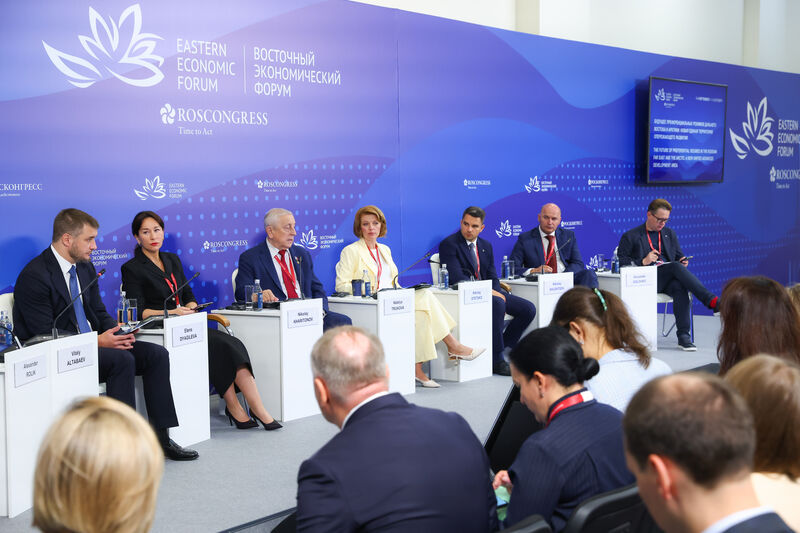
Elena Diaghileva, a representative of the Murmansk Region in the Federation Council, took part in the WEF session on the formation of a single territory of advanced development in the Arctic and the Far East. The session was moderated by Alexander Rolik, Senator of the Russian Federation from Primorsky Krai.
On the sidelines of the Eastern Economic Forum, the specifics of the formation of a single preferential regime for the Arctic zone of the Russian Federation and the Far East were discussed. Russian Senator Elena Diaghileva presented her view on the emerging outline of the future bill. She emphasized the direct relationship between the predictability of the rules of a single TOP and the development of territories.
"Our task is to make the rules uniform and understandable for the investor. The launch of new production facilities, job creation, infrastructure development and the quality of life of the people of the macroregion depend on this. But it is important to take into account the specifics of the Far East and the Arctic, where it is objectively more expensive to implement projects and conduct business," the senator noted.
The parliamentarian emphasized the need to pay special attention to fixing the investment threshold for obtaining resident status.
"Small and medium–sized businesses are not a secondary sector of the economy. These are jobs close to where people live, the availability of goods and services, the sustainability of municipalities, and the quality of life. In fact, small enterprises are the mainstay of the state in improving the quality of life in the Arctic and the Far East, as well as diversifying the economy," the senator explained.
Elena Diaghileva noted that this position is clearly indicated by the Governor of the Murmansk region, Andrey Chibis. So, at a meeting in the Federation Council, the head of the Arctic stressed that sustainable development of the northern territories is impossible without small and medium–sized businesses. The Murmansk Region is currently a leader in the number of residents and the volume of investments under preferential mechanisms. According to the representative of the region in the Senate, a single regime should be set up for both capital-intensive megaprojects and small industries.
The main topics of the session were the approach to the formation of a single TOP, the preferences available to investors within the framework of the emerging mechanism, as well as the effect it will have on the investment climate and attractiveness of the strategic macroregion. The discussion was attended by Vitaly Altabaev, First Deputy Minister of the Russian Federation for the Development of the Far East and the Arctic, Alexander Golovko, Executive Director of the Union of Residents of Preferential Regimes, Nikolai Stetsko, Deputy Chairman of the Government of Primorsky Krai, Natalia Trunova, Auditor of the Accounts Chamber of the Russian Federation, Nikolai Kharitonov, Chairman of the Committee of the State Duma of the Federal Assembly of the Russian Federation for the Development of the Far East and the Arctic, Nikolay Shlentsov, General Director of Primorye Sportotelinvest LLC. According to moderator Alexander Roller, the exchange of views on the new mechanism makes it possible to identify its strengths and growth points, and the proposals from the session participants will become the basis for finalizing this system, taking into account the interests of the state, society, business and residents of the Far Eastern and Arctic regions.
Recall that the task of launching a single preferential treatment for the Far East and the Arctic was set by Russian President Vladimir Putin at the WEF plenary session last year. The relevant law should be adopted by the end of 2026. The Chamber of Regions is actively involved in the process: on behalf of Federation Council Chairman Valentina Matvienko, a special working group under the Federation Council Committee on Federal Structure, Regional Policy, Local Self-Government and Northern Affairs was established in the Federation Council to prepare proposals for a strategic document.
Photo: Roscongress
/Ministry of Information Policy/