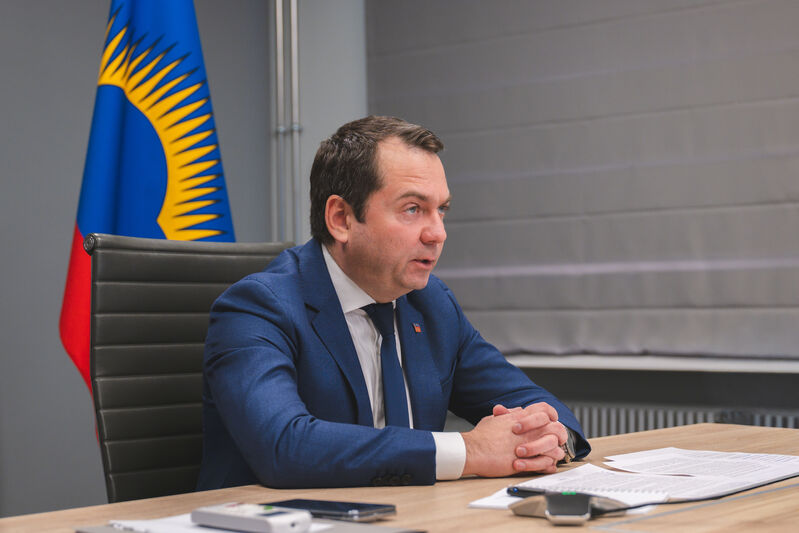
The Governor of the Murmansk Region, Chairman of the State Council of the Russian Federation’s Commission on the “Northern Sea Route and the Arctic” area, Andrei Chibis, took part in a meeting of the Council for the Protection of the National Interests of the Russian Federation in the Arctic and the Development of National and International Maritime Transport Routes. The meeting was chaired by Nikolai Patrushev, Assistant to the President and Chairman of the Maritime Collegium, and Yuri Trutnev, Deputy Chairman of the Government and Plenipotentiary Representative of the President in the Far Eastern Federal District. The main topic was ensuring the year‑round operation of the Trans‑Arctic Transport Corridor and finalizing the comprehensive project for the development of the Arctic and the TTC.
“First of all, I would like to express my gratitude to the Russian government for its work on developing the Arctic zone, because thanks to the decisions that are being implemented today, the cities of the Kola Arctic are changing, and for the first time since the USSR, housing construction is being actively carried out. And, of course, I thank you for supporting the comprehensive project,” said Andrei Chibis.
In his report, the governor emphasized the importance of synchronizing port capacities, railway infrastructure, and icebreaker support, and presented a number of proposals.
As the head of the region noted, with the support of the President of the Russian Federation, the first stage of the Murmansk Transport Hub has been practically implemented in the region: nearly 50 kilometers of railway and the Lavna port have been built. The next step is to increase the carrying capacity of the MTH to 45 million tons.
The cargo turnover of the Murmansk port in the first six months of 2026 demonstrates steady growth, and the dynamics of cargo flow along the Northern Sea Route since the beginning of the year confirms the route’s demand. The share of atypical cargo in the transportation structure is becoming increasingly noticeable, in particular, grain and metal; container traffic is developing, including with countries in Southeast Asia.
Given the President’s instruction to increase the volume of cargo transportation through Murmansk to 100 million tons by 2030, synchronizing the development of approaches and terminals is becoming a strategic task. To address this, the governor proposed introducing flexible railway tariffs and mechanisms to stimulate private investment in the accelerated development of infrastructure.
Another proposal is to improve the efficiency of using icebreaker capacities. As the governor noted, Russia has a unique position in terms of icebreakers — four new “atoms” are already in operation, and overall, this is our serious competitive advantage, which no other country in the world has. It is important to develop a mechanism for the rapid reallocation of icebreakers between ongoing projects — this will increase the fleet’s workload and speed up the development of the year‑round Trans‑Arctic Transport Corridor.
“We have everything to make the TTC one of the key international sea routes.” “We are faced with the common task of combining all available resources into a single, reliable, functioning system with a key hub in Murmansk,” said Andrei Chibis.
/Ministry of Information Policy of the Murmansk Regiongion/