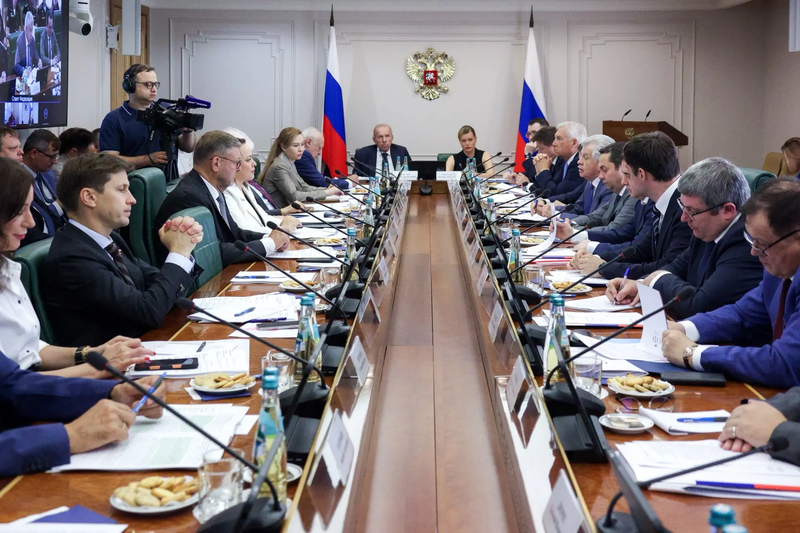
A round table dedicated to the development of the Northern Sea Route was held in the Federation Council in Moscow. Andrey Chibis, Governor of the Murmansk Region, Chairman of the State Council of the Russian Federation Commission on the Northern Sea Route and the Arctic, presented a comprehensive view of the prospects of the macroregion. On the agenda are strategic projects designed to strengthen the country's transport sovereignty and give a powerful boost to the Arctic economy.
Andrey Chibis stressed that the Arctic today is a new space. The Arctic zone of the Russian Federation occupies 30% of the country's territory and, with a population share of less than 2%, forms about 10% of national GDP. About 80% of gas production, 10% of oil production, and almost the entire volume of nickel, rare earth metals, platinoids, and apatite ores are concentrated here. These figures, according to the head of the region, clearly demonstrate why the development of the Arctic territories is an absolute priority of state policy.
The head of the region also noted that the Murmansk transport hub is a strategic facility for the whole country, ensuring not only the development of the Arctic, but also Russia's integration into the global economy. The geographical location of Murmansk, the world's largest ice—free port beyond the Arctic Circle, is unique. The port has direct access to the World Ocean and the shortest access to the Northern Sea Route, which is critically important in a changing foreign policy environment. It accounts for more than half of the total volume of cargo transshipment in the Arctic zone of the Russian Federation.
"We see this work as a complex. Expanding the capacity of the approaches to the port is not just an economic project, it is a matter of strengthening transport sovereignty and national security. Murmansk should become the most powerful logistics hub on the route of the Transarctic Transport Corridor. Let me remind you that Russian President Vladimir Putin has instructed to increase the carrying capacity and capacity of the MTU by at least three times by 2030-2035. The construction of new terminals and the development of railway infrastructure will allow for a multiple increase in cargo flows, including container cargo on North—South routes," the governor said.
Special attention was paid to the prospects of shipbuilding. Andrey Chibis noted the multiplicative effect of the shipyard construction in the region. This is not a single facility, but an anchor center, creating demand for metal, components, energy and engineering infrastructure, as well as forming an order for the training of qualified personnel.
"The development of shipbuilding and ship repair where we are not dependent on third countries is a fundamentally important issue for the new realities.
We recall the experience of the First and Second World Wars: today we must minimize risks and ensure the output of finished products from our own facilities," the governor stressed.
According to Andrey Chibis, the most important tool for launching large-scale container lines and loading TTK routes is a flexible approach to the formation of railway tariffs.
"In order for private investors to come to the port more actively, a small discount on the railway fare is needed. This will make it possible to boost infrastructure, attract cargo and, most importantly, create a reserve of capacities for force majeure scenarios related to geopolitical security. We need regulation at the federal level to understand where the goods should go first," the governor explained.
He added that flexible mechanisms for setting tariffs for specific destinations and types of cargo will ensure the loading of routes and attract new transit cargo, including from friendly countries. This is especially important against the background of the launch of a new container line through Murmansk and the growing interest from Belarus, the Republic of China and other partners.
Summing up, Andrey Chibis said that all these areas — the expansion of the MTU's carrying capacity, the development of shipbuilding and tariff incentives — will be included in the comprehensive project for the development of the Arctic zone of Russia and the Transarctic transport corridor.
"It's not just a set of solutions. This is a response to the challenges of the time and a strategic plan that allows us to develop the Far East and the North as priority areas. We have to present a comprehensive project to the President this year. Decisions have already been made, and some of them are awaiting approval. I am sure that this will provide serious opportunities for shippers and, more importantly, ensure reliable communication between the regions and strengthen our presence in the Arctic," said Andrey Chibis.
Photo: Parliamentary Photo Archive
/Ministry of Information Policy of the Murmansk Region/