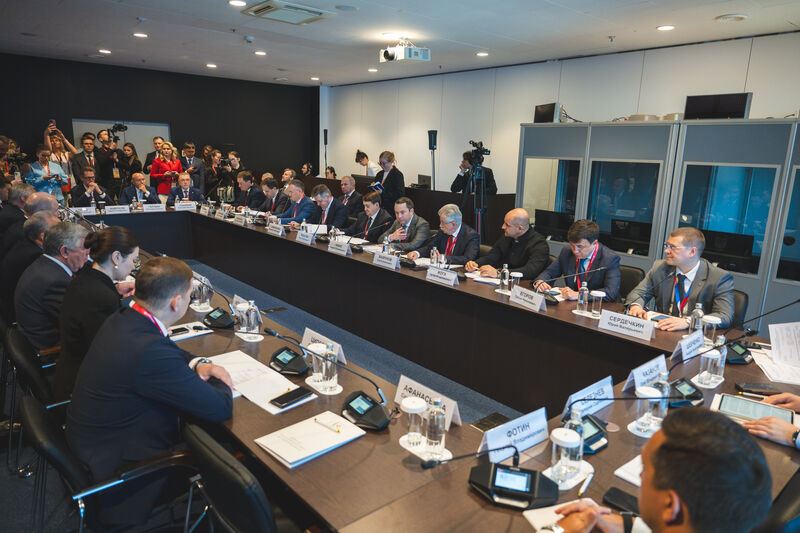
Within the framework of the St. Petersburg International Economic Forum, a meeting of the Commission of the State Council of the Russian Federation on the Northern Sea Route and the Arctic was held under the chairmanship of Andrey Chibis, Governor of the Murmansk Region. The participants discussed key approaches to the formation of a comprehensive project for the development of the Russian Arctic zone and the Transarctic transport corridor as the main tool for implementing the Development Strategy of the Russian Arctic until 2050, and also noted that the relevant commission has become the "voice of the regions" at the federal level.
Opening the meeting, Andrey Chibis stressed that the comprehensive project being developed should be a single state plan integrating all key areas of development of the Arctic zone with strict coordination at the federal level. The planning horizon is until 2050, with a detailed elaboration of measures for 10-15 years. This corresponds to a long payback period for large Arctic investments.
"There is a clear instruction from President Vladimir Vladimirovich Putin: The Government, together with the Marine Board and our Commission, must submit the draft to the head of state by the end of this year, in November. The existing centers of economic growth in the constituent entities of the Russian Federation play an extremely important role. Using the example of Yakutia and the Murmansk Region, we will discuss what should be reflected in this comprehensive project for the development of the regions. Our task is to clearly understand and reflect what the entity has and needs in terms of its role and tasks within the framework of a comprehensive project – infrastructure, support measures, technologies, what to do and launch, what is in the future. It used to be called Gosplan. Now it will be a clear plan, approved at the level of the head of state, with interconnected blocks in order to be able to attract private investment in the implementation of Arctic projects, including in the format of public-private partnership. An important goal is to ensure high–quality living conditions for people in the Russian Arctic," said Andrei Chibis, Chairman of the Commission and Governor of the Murmansk Region.
Sergey Vakhrukov, Head of the Office of the President of the Russian Federation for National Maritime Policy, stressed that the comprehensive project is important not only for the Arctic, but also for the whole of Russia, as it creates additional conditions for development and growth points.
"The most important principle of the project is complexity. This is not a list of individual projects, but a single interconnected project, all elements of which should be assembled into a single model for the development of the Russian Arctic, including the Transarctic Transport Corridor. The second principle is investment feasibility. A comprehensive project should be built not as an application for budget financing, but as an investment model. Budgetary funds, government support measures and long-term government guarantees should trigger the influx of private capital, funds from development institutions, the stock market and partners from friendly countries. Obviously, the implementation of such a project is possible only with the coordinated work of all interested parties – the Government of the Russian Federation, the Maritime Board, the State Council Commission, regions, state corporations, development institutions, business and international partners. To do this, a clear and understandable project management system must be built, performance indicators for its implementation and responsibility for the result must be determined. The project will enable the regions of the Arctic zone of Russia, as well as other regions closely linked to the Russian Arctic, to realize their existing economic potential, and will also contribute to improving the standard of living of the region's population," said Sergey Vakhrukov.
The project should have an impact on improving the quality of life in the Arctic territories. New jobs will be created at fields, ports and transport hubs. The implementation of master plans for the mainstay settlements of the Russian Arctic will ensure a comprehensive renovation of the urban environment and infrastructure development: for example, new roads, airports, including small aircraft, modern healthcare, education and cultural facilities will be built. Northern delivery will become more reliable and cheaper. The simplified tax regime in the Arctic special economic zones stimulates the development of small and medium-sized businesses. The expansion of the tourist infrastructure is expected. This gives people reasons to stay in the region and come there to work and live.
The comprehensive project is aimed at solving four interrelated tasks: ensuring national security, large-scale development of mineral resources with deep processing in the territory of the Russian Arctic, the formation of the TTK as a competitive transport artery of global importance, and accelerating the capitalization of the region's mineral resource potential.
During the discussion, special attention was paid to the regional dimension using the example of the growth points of the Murmansk Region and the Republic of Sakha (Yakutia).
"An integrated project is a portfolio of interrelated projects united by a common logic of technology, infrastructure and human potential development in a production and technological chain. Each project should be designed as a full-fledged investment structure with a sound economic model. Thus, the Murmansk Region has a unique set of resources and infrastructure, but the main reserve for development is the creation of a new metallurgical industrial cluster for processing resources. It is important not to increase the export potential, but to reassemble the technological chain so that the maximum added value is created in our country and ensures the technological sovereignty of the country," commented Alexander Galushka, President of the Kristall Rosta Foundation.
It was noted that the comprehensive project will have a positive socio-economic impact not only on the Arctic regions of the Russian Federation. For the development of the Arctic and the development of the TTC, it provides for the use of the scientific and technical potential of the entire country, reducing dependence on foreign technologies, especially in the field of shipbuilding. Additional budget revenues from the development of deposits will be used for social needs. A single plan with predictable infrastructure reduces risks for investors and reduces the cost of logistics. Climate and permafrost research projects lead to more accurate weather forecasts and reduced risks to infrastructure.
For the operational management of the project, the creation of the Arctic Development Corporation and the TTK is being considered, which will ensure the synchronization of all activities. The issue of Arctic bonds is also being considered. Fundamental issues will be discussed at the level of the Council for Strategic Development and National Projects.
The Commission of the State Council of the Russian Federation on the Northern Sea Route and the Arctic was established by Decree of the President of the Russian Federation in July 2024. Andrey Chibis, Governor of the Murmansk Region, has been appointed Chairman of the commission.
For reference:
The Arctic zone of the Russian Federation occupies 30% of the country's territory and, with a population share of less than 2%, forms about 10% of national GDP. About 80% of gas production, 10% of oil production, and almost the entire volume of nickel, rare earth metals, platinoids, and apatite ores are concentrated here. Over 35 trillion rubles of investments have been attracted to the development of the Russian Arctic. In 2024, cargo traffic along the Northern Sea Route reached a historic high of almost 38 million tons.
/ Ministry of Information Policy of the Murmansk Region /