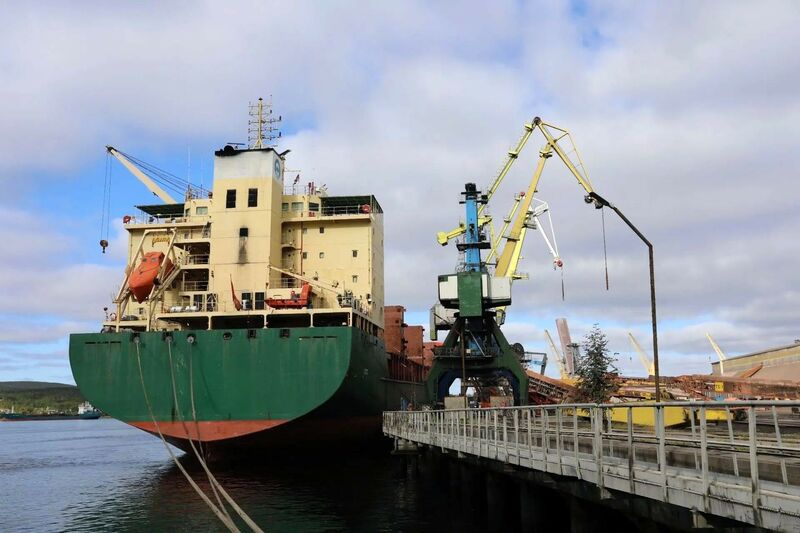
At the Murmansk bulk terminal, a container ship belonging to New New Shipping Line, which arrived from China via the Northern Sea Route, is being loaded. After unloading 502 containers with imported automotive components at the Murmansk Commercial Sea Port, the vessel moved to the MBT berths, where the loading of the export cargo — 26.4 thousand tons of potash fertilizers — began. On the return voyage, the products of the Russian manufacturer will be sent to the countries of Southeast Asia.
The railway component has become an important element of the logistics chain: containers that arrived in Murmansk by sea have been transferred to the railway and will be shipped across Russia. The first batch of auto components has already been dispatched and will arrive at the facility in the near future. This scheme makes it possible to efficiently distribute imported cargo within the country and, at the same time, to form an export load for the return voyage.
“We are not testing a single operation, but the entire logistics scheme as a whole — from the containers delivered to the MMC port to the loading of potassium onto the MBT. It is important for us to understand how sustainable this route is, how convenient it is for the participants in the chain, and how economically viable it is,” said Vladislav Yakuchuk, Commercial Director of the MBT and MMC port.
Of particular importance is the integration of the “Big Ring” logistics scheme, developed by the National Transport Company with the participation of the Port Alliance, into the voyage. Its essence lies in practically eliminating empty runs of hopper cars: after unloading potassium in Murmansk, the cars are loaded with apatite raw materials and then proceed to processing plants in the Leningrad Region and Krasnodar Territory, and then return to pick up a new batch of cargo. This reduces transportation costs and makes the route economically viable.
The pilot run became a large‑scale test for the entire Murmansk transport hub. The sequential handling of the vessel at two terminals has confirmed that the region’s port infrastructure is capable of accommodating through international routes. The Murmansk Arctic route opens up new opportunities for logistics not only for Russia but also for neighbouring states, forming a modern multimodal transport system in the Arctic zone.
— The launch of the Murmansk Arctic route via the Northern Sea Route is a test of the readiness of our port and logistics infrastructure for new formats of international communication. The Murmansk Region demonstrates that it is capable of handling complex transit cargo flows, ensuring efficient backloading, and serving as a reliable link between manufacturers in Russia and Asian markets. Our goal is to further develop the transport hub and create conditions under which such routes will become regular, not just pilot ones, said Svetlana Panfilova, Minister for the Development of the Arctic and the Economy of the Murmansk Region.
Experts will provide a final assessment of the route’s economic efficiency for all participants in the chain once the full cycle of the voyage is completed.
Photo: Murmansk Bulk Terminal
/Ministry of Arctic Development and Economy of the Murmansk Region/