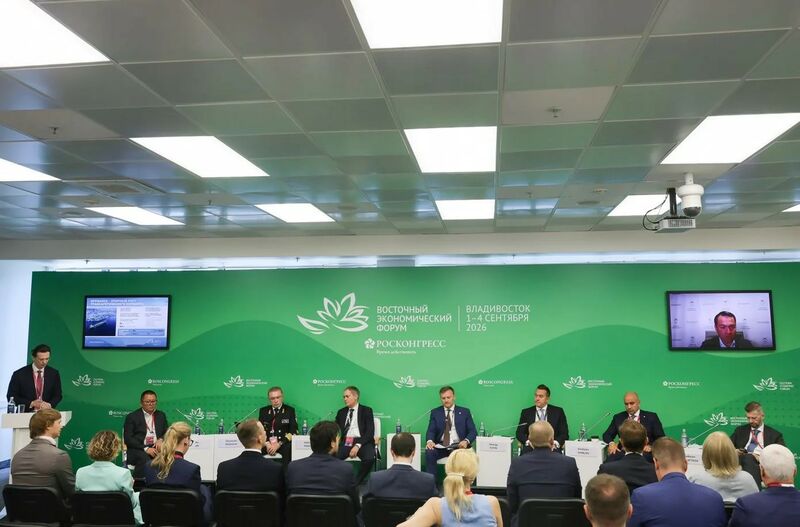
How to extend navigation along the Northern Sea Route and ensure the readiness of the fleet, infrastructure and market was discussed today on the sidelines of the Eastern Economic Forum. Andrey Chibis, Governor of the Murmansk Region, Chairman of the State Council Commission on the Northern Sea Route and the Arctic, stressed that when implementing infrastructure development projects for the Northern Sea Route as an essential element of the TTC, it is important to proceed from strategic government objectives and long-term economic benefits for the country.
"I want to remind all of us that if the decision to build the Trans–Siberian Railway had been made based on an assessment of the economic feasibility at the moment, Russia would not have had the Trans-Siberian Railway. The same story concerns the development of the Northern Sea Route and a broader logistics route, the Transarctic Transport Corridor. We must proceed from the fact that there are strategic state tasks. And often, when implementing such projects, decisions need to be made, even if at a moment – for example, when the cost of coal is falling – a specific route has lost relevance. But it can have a huge economic effect for the country in the future, which is exactly what happened with the Trans–Siberian Railway. When this decision was made, it was a very difficult time for the country, nevertheless, the decision was made. And now we see how important this turned out to be for the country's security and what a powerful impetus it gave to the development of many regions of the then Russian Empire," the governor emphasized.
Andrey Chibis noted that the Arctic and its development are of crucial importance for Russia today and for the global economy: projects implemented here already create about 10% of the Russian Federation's GDP, despite the fact that less than 2% of people live there. The main volume of gas production, nickel production, extraction of rare earth metals, platinoids, and apatite ores is concentrated here, from which the purest fertilizer in the world is made, which feeds almost a third of the planet.
"Today, we all, the whole country, are faced with the task of integrated development of the Arctic zone of the Russian Federation and the Transarctic Corridor, one of the key goals of which is to build a strong link between the Arctic logistics system and production chains and the rest of the country's regions. It is important to understand that it is precisely this comprehensive, systematic approach that will unlock the full potential of the Russian Arctic. The Transarctic Transport Corridor, which includes the Northern Sea Route, is a fundamentally important alternative artery that is 40% shorter than the traditional route through the Suez Canal. Russia, thanks to its icebreaking fleet, ensures navigation along the NSR and full control over logistics in this region, Russia's full national sovereignty, and is responsible for the safety of this route. That is why last year at the International Arctic Forum we discussed the topic of a comprehensive project for the development of the Arctic and the TTC. The President has made a decision: such a project must be implemented. Today, with the participation of the relevant Commission of the State Council, the Arctic regions, colleagues from the Russian Government, the Presidential Administration, and the Maritime Board, this comprehensive project is being developed, which should take into account all the possibilities of the new logistics system, aspects of the development of the existing infrastructure, the creation of a platform for attracting private capital to its development and the active rollout of the NSR," said the head of the Murmansk Region.
Andrey Chibis recalled that Murmansk is the world's largest ice–free deep-water port, the mainstay for the TTC, the base of the Russian icebreaking fleet, has direct access to the world ocean without passing through international straits, and is not limited in size by incoming vessels. Lavna Port, one of the most modern transshipment complexes in Russia, has been launched here, and active work is underway to organize container transportation. The port is universal for any cargo.
"This is a huge competitive advantage for the country. In terms of cargo turnover, the port of Murmansk is the leader of the Arctic basin: in 2025, transshipment amounted to about 47 million tons, and in the first six months of 2026, cargo turnover increased by 13 percent compared to the same period last year. This requires active, full-fledged development. It is fundamentally important for the country to prioritize investments in the port of Murmansk," said Andrey Chibis.
The head of the Murmansk Region noted that the urgent task is the comprehensive development of the Murmansk transport hub.
"We have recently built a new railway, almost 50 km, connecting the western and eastern shores of the Kola Bay. The first modern Lavna port since the Soviet Union was built. Now it is necessary to expand railway approaches, especially long-distance ones, in order to increase the volume of cargo. This work is currently underway, by the end of 2027 it will be 45 million tons," the governor said.
The head of the Murmansk Region named cargo diversification as the second task.
"We are actively working to make the port of Murmansk an international logistics hub. We are rolling out the route with our Chinese partners. Recently, the first container ship arrived from China. We also agreed with partners from the Republic of Belarus that Murmansk will become a window for container shipments to provide equipment for both the economy and enterprises. Work is also underway with partners from India to ensure constant, systematic delivery," said Andrey Chibis.
The governor noted the development of ship repair and shipbuilding as one of the most important elements of the emerging integrated project for the development of the Arctic and the TTC as the third key task.
"Together with our partner companies, we are implementing a number of projects. A ship repair plant is being revived and is developing, and we are working on a project to produce floating power units. And the next obvious step is the creation of a new shipyard in the Murmansk Region to provide the Arctic fleet with merchant shipping along the TTK routes. The concept and justification are being prepared," the governor said.
The discussion was attended by Alexander Poshivai, Deputy Minister of Transport of the Russian Federation, Vladislav Kuznetsov, Governor of the Chukotka Autonomous Okrug, Pavel Andreev, Chairman of the Board of Directors of Eco Shipping LLC, Rosatom State Corporation Special Representative for Arctic Development and Vladimir Panov, Deputy Chairman of the State Commission for Arctic Development, Vladislav Sviblov, General Director of the Areal International Atomic Energy Agency, Georgy Fotin, General Director of the Baimskaya Management Company, Permanent Deputy Chairman, Council for the Development of the Arctic at Chinese Enterprises; Managing Director, New New Shipping Ke Jin.
/ Ministry of Information Policy of the Murmansk Region /
Photo: Kirill Bolotov, Roscongress