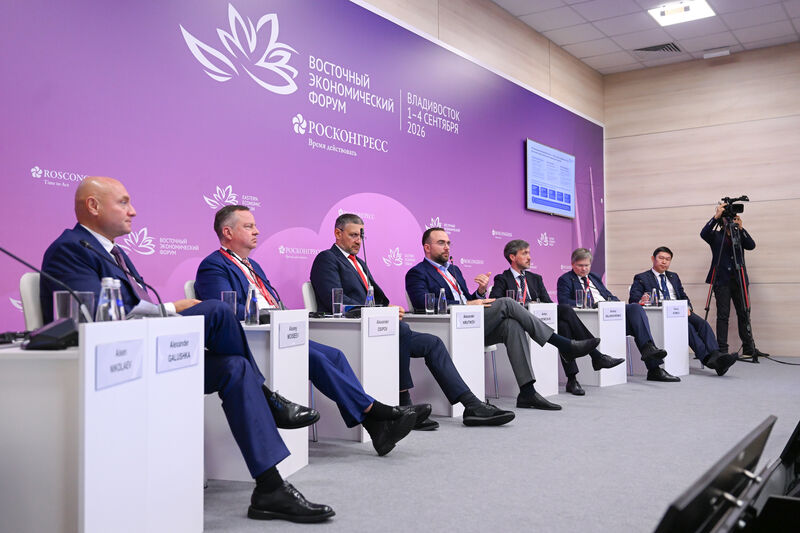
Svetlana Panfilova, Deputy Governor and Minister of Arctic Development and Economy of the Murmansk Region, took part in the session "From Budget dependence to Investment Independence: how can regions raise capital on the stock market?" at the Eastern Economic Forum. The key topic of discussion was the tools for attracting extra-budgetary investments in the Arctic and the Far East.
Currently, on behalf of Russian President Vladimir Putin, a single Comprehensive project for the development of the Russian Arctic and the Transarctic transport Corridor is being formed. At the WEF plenary session, the head of state stressed that the document, designed until 2050, should "stitch together" the logistics space of the Far Eastern and Arctic regions, and instructed the Russian Government to promptly finalize it and begin implementation. The Transarctic corridor — from St. Petersburg and Murmansk via the Northern Sea Route to Vladivostok and further to the countries of the Asia-Pacific region — is designed to provide flexibility and security of international supplies, open up new opportunities for transit and coastal transportation. According to the President, by the end of this decade, the volume of transportation through the TTC should grow at least twice — up to 70 million tons per year.
In this scheme, the Murmansk region is the western gateway of the corridor and a reference point for the growth of cargo traffic.
— In the Arctic, this infrastructure is less accessible: a deposit cannot be developed without a transport shoulder, a port without railway approaches and energy will not work, a city without infrastructure will not hold people. Therefore, a comprehensive project is not a sum of individual initiatives, but a single assembly: deposits, ports, railway approaches, energy, fleet, processing and urban infrastructure are interconnected in terms of time, capacity and money," said Svetlana Panfilova.
Svetlana Panfilova also presented the mechanics of off-budget financing of promising projects through the investment lots tool. The government forms a single portfolio of projects necessary for the development of the region and distributes them into economically separate lots, each of which represents a specific project: for example, the construction of a port terminal, the development of a deposit, the creation of a logistics center or the construction of a railway section. Each lot is accompanied by a calculated business model, risk assessment and a set of government support measures ‑ tax benefits, subsidies, rights to use mineral resources, guarantees. Lots are offered to private investors on transparent terms.
This approach is fully consistent with the course set by Russian President Vladimir Putin: from January 1 next year, a single preferential regime will begin to operate throughout the Far East and the Arctic, where support tools are tailored to activities rather than linked to a specific zone. The "benefits menu" for investors is exactly what makes an investment lot attractive.
Svetlana Panfilova emphasized that the Murmansk Region is working to create new growth points connected by a single engineering, transport, energy and social infrastructure. Five industrial clusters are considered as priority capitalization zones of the region within the framework of the Integrated Project: mining and metallurgical, transport and logistics, gas processing cluster, marine engineering and technology cluster, and bioeconomy cluster. At the same time, it is important to form new centers of economic growth, and not just to equip existing ones.
The head of the Republic of Sakha (Yakutia), Aisen Nikolaev, presented the experience of his region. Yakutia, together with the Crystal Growth Foundation and with the support of the Ministry of Finance, is developing the country's first Regional Capitalization Strategy: more than 20,000 enterprises have been analyzed, 100 have been selected, and a pool of 15 companies with varying degrees of IPO readiness is being worked out. Nikolaev emphasized the mechanism of the regional option — tax benefits for businesses as an investment of the region in the project with the opportunity to get a share in the company. The region does not claim control, but participates in the growth of value and receives dividends. According to Aisen Nikolaev, this tool is especially relevant for the Far Eastern and Arctic regions with large investment projects.
Photo: Roscongress
/Ministry of Arctic Development and Economy of the Murmansk Region/