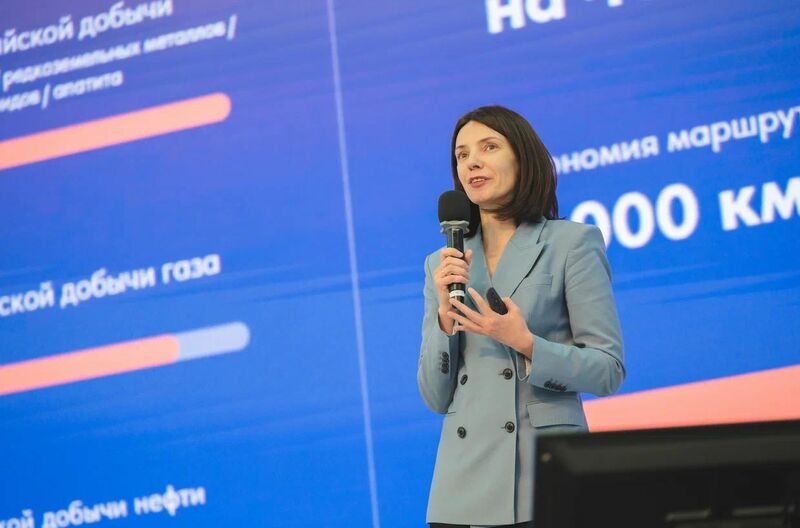
Deputy Governor of the Murmansk Region — Minister for Arctic Development and Economy Svetlana Panfilova took part in the plenary session of the August Meeting of Educators “The Arctic of the Future: The Role of Education in the Region’s Development” and spoke about the economy of the Murmansk Region as the foundation of the human resource potential of the Russian Arctic.
The importance of the Arctic zone is rapidly growing: today, up to 10% of the country’s GDP is produced there, despite the population being less than 2%. The President of Russia has supported the initiative to create a separate comprehensive project for the development of the Arctic zone of the Russian Federation and the Trans‑Arctic Transport Corridor — a single state plan that integrates all key areas of Arctic development.
Five industrial clusters have been identified as priority growth points for the Murmansk Region: mining and metallurgical, transport and logistics, gas processing, a cluster of marine equipment and technologies, and a bioeconomy cluster. The region is rightfully called Russia’s mineralogical “treasury” — about 20 % of all known minerals are concentrated in its subsoil. The Murmansk Region is becoming the flagship region for the resumption of lithium mining, a strategically important metal for the production of batteries and electronics.
Among the key events is the creation of the Lavna commercial seaport, the first port built in the region since Soviet times; and the arrival of the first international container ship, New New Shipping Line, from China via the Northern Sea Route to Murmansk. Work continues on restoring the capacity of the Murmansk Shipyard, where the PD-51 floating dock, the largest in Northwestern Russia, has already been delivered.
Large—scale projects create a personnel demand: today about 60,000 people are employed in the region's industry, and by 2029 another 7,700 high-paying jobs may be created - engineers, electromechanics, mining engineers and metallurgists. That is why systematic career guidance work with young people is a priority for the government of the Murmansk region within the framework of the national program "Live in the North!".
Agrotechnological and media classes have appeared in the region's schools. The network of specialized classes already includes more than 80 engineering classes and over 60 medical and psychological‑pedagogical classes. The field is actively developing thanks to partnerships with industrial enterprises: companies participate in the development of educational programs and projects, such as the “Miner of the Future” project with PhosAgro, the “Metallurgist of the Future” project with Norilsk Nickel, the “Energy Worker of the Future” project with Rosatom, as well as the technology‑focused program supported by NOVATEK; they provide platforms for practical training and mentors.
By 2030, 100% of schools in the Murmansk region will have industrial partners. Already, more than 300 schoolchildren are mastering in‑demand professions through 16 programmes, including new areas such as chemical analysis laboratory technician, additive equipment operator, and 3D printing operator.
“Modern industry is a whole world of advanced technologies, breakthrough ideas, and interesting challenges.” It opens up broad opportunities for realizing one’s potential: here, you can not only build a career but also become part of important transformations, strengthening our country’s economic independence. At the same time, behind every major project are people: engineers, workers who lay the foundation for the region’s future through their labour. It is their professionalism and determination that make any large‑scale changes possible, and our task is to help young people see this connection, to understand that the contribution of every specialist is truly significant,” Svetlana Panfilova emphasized.
With the support of the regional Ministry of Arctic Development and Ecomomics, other career guidance formats are being developed. Investment lessons are being held: during excursions to the Murmansk Region Development Corporation, schoolchildren and students get acquainted with the mechanisms for implementing investment projects, learn about promising industries and competencies that will be in demand in the future economy. Professional tours to investment sites have become a key format — the Kola VES, the Lavna port, the Marine Construction Center, the Udarnik terminal, and other facilities. Professional tours are organized, giving young people the opportunity to “try on” a profession and get to know potential employers.
A comprehensive approach — from specialized classes with industrial partners to professional tours at major production facilities — helps the younger generation understand that the Murmansk Region is a territory with ample opportunities for professional growth and a conscious choice of a future profession.
/Ministry of Arctic Development and Economy of the Murmansk Region/