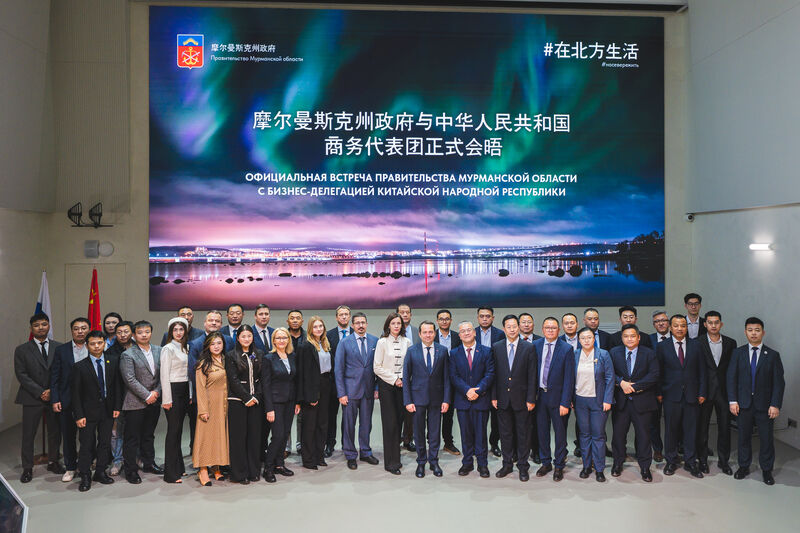
Murmansk received the first container ship of the international container line New New Shipping Line, which arrived from China via the Northern Sea Route. The solemn ceremony to welcome the vessel took place at the Murmansk Sea Commercial Port, and the crew was personally greeted by Governor Andrei Chibis. The event was also attended by Chinese Consul General in St. Petersburg Luo Zhanhui, CEO of New New Shipping Line Ke Jin, representatives of Chinese companies, the Center for Foreign Economic Activity of the Russian-Chinese Guild of Commerce, the Union of Chinese Entrepreneurs in Russia, the Oktyabrskaya Railway, as well as the management and specialists of MMTP and the Port Alliance.
"The development of the Transarctic transport corridor is one of the key tasks for the country, and we have been working on it for several years: a specialized commission is working, the infrastructure is being prepared, and the transport hub itself is gradually increasing its capacity. This is exactly what we talked about a year ago at SPIEF, when we set the goal of making Murmansk the main container hub in the Arctic. And today, when a container ship from China arrived at the port via the Northern Sea Route for the first time in history, we took the first step towards realizing this goal. This opens up additional opportunities for utilizing the port infrastructure, developing international transportation, and strengthening Murmansk’s role as the main center of Arctic logistics — and therefore benefits the economy of the entire country. But just as importantly, it benefits the people. Containers are a sealed cargo, and as the port expands its range of products in this direction, the load on the city is reduced. In addition, the development of the port as a logistics hub will ensure the creation of new jobs and an increase in taxes for the budget,” said Andrei Chibis, Governor of the Murmansk Region and Chairman of the State Council of the Russian Federation’s Commission on the “Northern Sea Route and the Arctic” area.
The ship delivered 502 containers with automotive components to the port. After unloading at the Murmansk Commercial Sea Port, the cargo will be shipped by rail to consumers in Central Russia. Railway infrastructure plays a key role in the development of transportation. The Murmansk Transport Hub provides an effective logistical link to the country’s main centres, enabling the organisation of multimodal transportation and maintaining the regularity of deliveries. Further work to develop the network of railway approaches to the MTU, carried out by the government of the Murmansk Region, will make it possible to ensure high delivery speeds for goods even over long distances. This leads to an increase in the competitive speed of cargo delivery, which is especially important for modern logistics chains.
In 2025, a specialized terminal was established at the port with the support of the port holding company “Port Alliance” to handle containers. This created the basic conditions for working with a new type of cargo.
“The arrival of the first vessel with containers confirms the readiness of the MCTP to handle container cargo and expand the range of services for shippers.” One of the key advantages of the port is its versatility: deep‑water berths, year‑round navigation, the necessary equipment and an experienced team allow us to quickly adapt production processes to market demands,” said Andrei Riznichenko, acting executive director of the MSPP. Historically, the MSPP specialized primarily in the transshipment of bulk cargo. Given the changes in trade routes and the structure of demand, the port is consistently expanding the range of cargo it handles and strengthening the competencies of the universal terminal, including work with general, regional and container cargo.
After unloading the containers, the vessel will take on board 26,400 tons of potash fertilizers from a manufacturer in Central Russia for shipment to countries in Southeast Asia. This will make it possible to test a pilot voyage in both directions: receiving container cargo from China and exporting Russian fertilizers.
“It is important for us that the voyage involves operations in both directions.” This format makes it possible to build a more balanced logistics chain between China, Russia, and the countries of the Asia‑Pacific region in practice, increasing the efficiency of fleet use and creating a foundation for the further development of cargo flows,” said Ke Jin, a representative of the New New Shipping Line.
Murmansk is the largest ice‑free port beyond the Arctic Circle with direct access to the World Ocean. Its strategic importance is enhanced by the fact that the route through the NSR is 40% shorter than the route through the Suez Canal, and the possibility of year-round navigation, well-developed infrastructure and multimodal capabilities make it attractive to shippers. The development of the container route at the MMTP is considered as a pilot stage: the possibility of switching to regular service will be determined by the results of the flight, the stability of the cargo base and the economic efficiency of the route. The launch of the line will strengthen the role of Murmansk as a reference port for the Transarctic Transport Corridor and the Northern Sea Route, as well as expand opportunities for international cooperation and cargo turnover growth.The ship visit is complemented by a business mission led by Mr. Zhou Liqun, Chairman of the China General Trade Union. The delegation includes about 30 representatives of leading Chinese corporations, including the management of New New Shipping Line, China Railway Construction Corporation (CRCC), China Communications Construction Company (CCCC), Geely Automobile and Alibaba Group, as well as representatives of the tour.
/Ministry of Information Policy of the Murmansk Region/