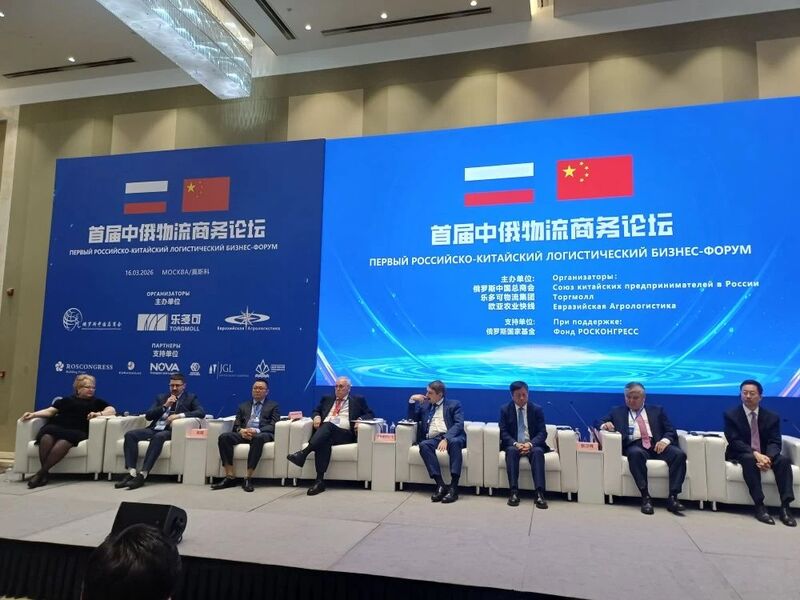
The Russian-Chinese Logistics Business Forum "New Horizons and Opportunities" was held in the capital, bringing together key representatives of the transport industry, industry and business circles of the two countries. The main topic of the event was the prospects for more active interaction and cooperation in the field of transport, logistics and infrastructure construction in the context of worsening global instability.
The forum was organized by the Union of Chinese Entrepreneurs in Russia with the support of the Roscongress Foundation and the Embassy of the People's Republic of China in the Russian Federation.
In an invitation letter to the forum participants, Zhou Lijun, Chairman of the Union of Chinese Entrepreneurs in Russia, stressed the steady dynamics of bilateral economic relations. He recalled that the trade turnover between the two countries has exceeded the 200 billion USD mark for the third year in a row.
"With the development of cooperation between Russia and China in the logistics sector, we expect a significant increase in bilateral trade and direct investment in the industry. A special focus is on the development of the Northern Sea Route or, as we also call it, the Ice Silk Road," Zhou Lijun said.
During the plenary session "Strategic Partners in the Construction of Eurasian Arteries", Artem Kuksa, Director General of the Murmansk Region Development Corporation, emphasized the strategic importance of developing the Murmansk transport hub. He noted that the transportation capacity of the hub will reach 45 million tons after completion of all procedures, including the modernization of long-distance railway approaches to the port of Murmansk. The implementation of these plans is directly related to the instructions of Russian President Vladimir Putin, who in March 2025 at the International Arctic Forum in Murmansk supported the initiative to create a new transport corridor and increase the port's capacity.
"The Port of Murmansk is Russia's gateway to the Arctic and a key hub of the Transarctic transport corridor, which is playing an increasingly important role in global logistics,— commented Artyom Kuksa, CEO of Murmansk Region Development Corporation. — Its development will allow not only to increase cargo turnover along the Northern Sea Route, but also to create new international logistics chains that reduce dependence on traditional southern routes. This is a matter of Russia's economic security and, at the same time, a contribution to creating a sustainable alternative for global trade."
In addition, he presented concrete steps for the development of container transportation. In September 2025, the government of the Murmansk Region signed an agreement with the Chinese shipping company NewNew Shipping Line.
"As part of this agreement, we are actively preparing for the launch of the first container flight through the port of Murmansk in the summer navigation of 2026. At the same time, the issue of forming a backload from Russia to China is being worked out," said Artyom Kuksa.
In addition to logistics, a significant part of the presentation was devoted to the prospects of industrial cooperation. Given the shortage of ice-class vessels and the active development of navigation along the Northern Sea Route, the Murmansk Region considers the construction of new vessels as a priority. As Artyom Kuksa noted, the project to create a shipyard in the region is at the stage of preparing a general concept, and Chinese partners will be involved in its implementation. This will strengthen the industrial potential of the region and meet the growing needs of Arctic shipping.
The New Horizons and Opportunities Forum has become a platform for systemic dialogue, confirming the mutual interest of Russia and China in deepening cooperation in the Arctic zone, developing transport infrastructure and implementing long-term investment projects.