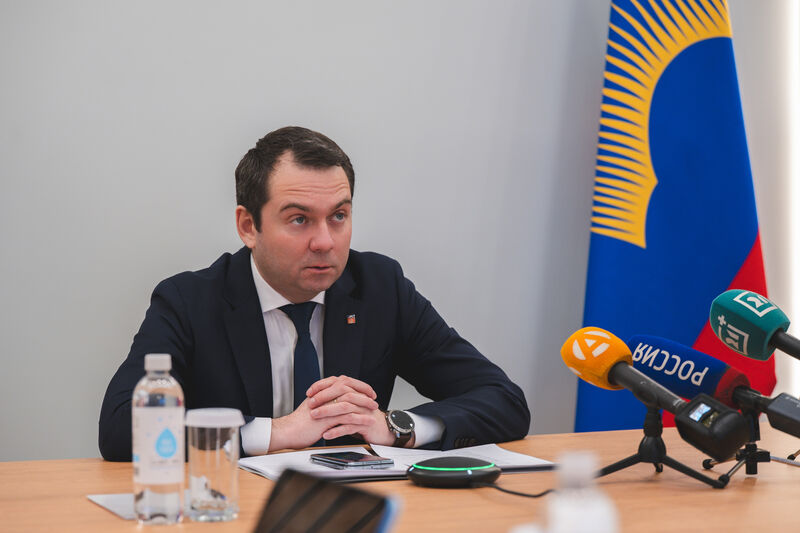
A meeting of the Commission of the State Council of the Russian Federation on the Northern Sea Route and the Arctic was held today under the chairmanship of Andrey Chibis, Governor of the Murmansk Region. The participants discussed proposals to adjust the planned changes in tax legislation regarding the simplified taxation system (STS) for small and medium-sized businesses operating in the Arctic zone of the Russian Federation.
Opening the meeting, the head of the commission proposed to ease the tax conditions for small and medium-sized businesses in the Arctic.
"Entrepreneurs, small and medium-sized businesses operating in the Arctic should have different, preferential tax conditions in comparison with those that apply in the whole country. The working conditions here are more complicated, the costs are higher, and the thresholds that have been approved at the federal level today certainly require careful assessment and appropriate adjustment proposals. We have expressed this position before," Andrey Chibis emphasized.
The Minister of Tourism and Entrepreneurship of the region Marta Govor presented an analytical report on the consequences of the changes. The head of the department said that the reduction of the annual income threshold for the use of the tax system from 60 million to 10 million rubles, proposed from 2026, if exceeded, the obligation to pay VAT arises, creates significant risks for doing business in the Arctic regions. Taking into account the specifics of the northern territories, the harsh climate and remoteness from the main markets in the Arctic regions, the traditionally high cost of goods and services, logistical and social costs. Therefore, the changes proposed by the new law may lead to higher prices, lower profitability of enterprises and the departure of some businesses to the shadow sector. The new conditions may become especially difficult for small businesses.
"In the Arctic regions, the share of revenue allocated to pay taxes already significantly exceeds the national average: in the Chukotka Autonomous Okrug it is over 7%, in the Republic of Sakha (Yakutia) — about 10%, in the Komi Republic – 11%, while the national average does not exceed 3.4%. According to the assessment carried out by the Commission's staff, if the current version of the draft law is maintained, the additional tax burden on SMEs in the Murmansk Region may exceed 5.7 billion rubles per year from 2028, which will lead to an increase in the cost of goods and services and an increase in the cost of living in the Arctic," said Marta Govor.
In addition, the issue of maintaining preferential insurance premium rates for SMEs was discussed. According to the draft federal law, it is planned to cancel the benefits of insurance premiums and switch to the general terms of their accrual. For the Arctic regions, where wages are based on regional coefficients and allowances, this will lead to additional cost increases and may lead to job cuts.
A number of mechanisms for correcting the situation were announced. Among them is the establishment of a special approach to gradually increasing the threshold of annual income for SMEs in the Russian Arctic: an increased revenue threshold for the obligation to pay VAT is 20 million rubles, with a phased change (40 million rubles from 2026, 30 million rubles from 2027, 20 million rubles from 2028). It is also proposed to include the activities of SMEs registered in the Arctic zone in the list of priority activities for the application of a reduced insurance premium rate and to consider the possibility of introducing an additional preferential VAT rate for Arctic entrepreneurs with an income of 20 to 60 million rubles. The proposals are aimed at preserving the sustainability of small and medium-sized businesses, increasing the investment attractiveness of the Arctic zone and preventing the growth of socio-economic imbalances in the northern regions.
The commission members and representatives of the Arctic regions unanimously supported the need for adjustments and mitigation of conditions. Their proposals, taking into account the specifics of each subject, will also be taken into account in the protocol.
"The Arctic zone is a territory with special working conditions. The high cost of production of goods and services, infrastructure constraints, and the complexity of delivery. Without maintaining favorable business conditions, it will be difficult to achieve an improvement in the quality of people's lives and sustainable economic growth. We consider the adjustments extremely important, we support the proposal and are ready to speak at any level," said Alexander Tsybulsky, Governor of the Arkhangelsk Region.
The position of the Federal Ministry of Finance was also heard during the meeting.
"The Far North, the Arctic, and the Far East have their own specifics. It is not easy to attract entrepreneurs here, to create conditions for business to function. This is especially true in remote areas. The mechanisms of benefits that subjects had, preferential taxation, and social aspects produced effects. We have no doubt that the adopted changes will worsen the situation of entrepreneurship in the Arctic, representatives of all subjects expressed this. But in order to have really convincing, concrete data on the dynamics, let's look at how the processes will move together with the business. And taking into account the first quarter of next year, in late March or early April, we will hold expert discussions at the commission and propose clear adjustments or additional support measures," Andrei Chibis summed up.
The Commission of the State Council of the Russian Federation on the Northern Sea Route and the Arctic was established by Decree of the President of the Russian Federation in July 2024. Andrey Chibis, Governor of the Murmansk Region, was appointed Chairman of the commission.
For reference:
According to the data of the subjects of the Russian Arctic, the most vulnerable category of entrepreneurs are companies with annual incomes from 10 to 20 million rubles — they account for about 47% of all SMEs with revenues from 10 to 60 million rubles. For such enterprises, even minor fluctuations in income can lead to the loss of tax benefits. The abolition of benefits on insurance premiums and lowering the threshold of the tax burden can lead to an increase in the tax burden in the Arctic by more than two times compared with the average Russian level.
/ Ministry of Information Policy of the Murmansk Region /