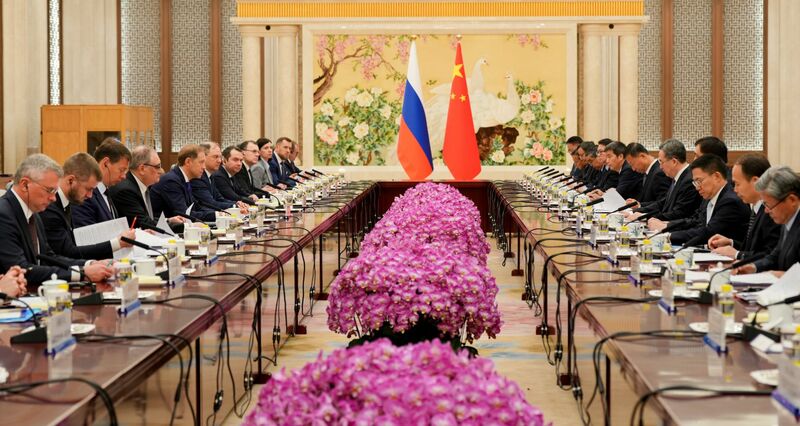
A meeting of the Intergovernmental Russian-Chinese Commission on Investment Cooperation was held in Beijing. The Russian delegation, led by Denis Manturov, First Deputy Prime Minister of Russia, included Andrey Chibis, Governor of the Murmansk Region.
The parties discussed the implementation of joint investment projects and further steps to expand international cooperation. The meeting was held on the eve of the 30th regular meeting of the heads of government of Russia and China.
Denis Manturov noted that over the past four years, the volume of bilateral trade has more than doubled, to $245 billion. An updated intergovernmental agreement on the promotion and mutual protection of investments is due to enter into force in December this year, which will speed up investment authorization procedures and improve investor rights protection.
"Today, the IPC focuses on a portfolio of projects totaling more than $200 billion. More than half of this amount is accounted for by 63 significant projects, of which 46 are already in the practical stage of implementation. We are mainly talking about initiatives for the development of transport and logistics infrastructure, metallurgy, chemistry, mechanical engineering, the forestry industry, the agricultural sector and the trade sector. It is important that this list is constantly expanding. This year, it includes new initiatives for the production of automotive equipment in three Russian regions and alumina in the Chinese province of Hebei," the First Deputy Prime Minister said.
The head of the region spoke about the development of the Murmansk Region and the implementation of strategically important Arctic projects in the territory. The Governor stressed that China is one of the largest trading partners of the Murmansk Region: over the past 5 years, trade turnover has increased 7.2 times. The main export directions are nickel and its products, fish and seafood, iron ore concentrate, machinery, equipment and metals are imported. Last year, 26,000 Chinese tourists visited the Murmansk Region, which is a third of the total foreign tourist flow.
"The Murmansk Region is the flagship of the development of the Russian Arctic, and Murmansk is the Arctic capital, as Russian President Vladimir Vladimirovich Putin noted. We have a preferential regime for the Arctic zone of the Russian Federation, which includes a set of tax incentives for investment projects, various preferences and the possibility of creating a free customs zone. Projects related to the Transarctic Transport Corridor, the shortest and most convenient year–round artery for cargo delivery, by the Northern Sea Route, are actively developing. We have a common interest here with our Chinese partners. Murmansk is a key deep–sea ice-free port providing this route. It has direct access to the World Ocean, which eliminates the risks of negative actions by unfriendly countries. We have a unique icebreaking fleet based here, which ensures uninterrupted navigation. To develop initiatives for the development of the route, the President created a special commission of the State Council, which works under my leadership, and also gave a number of instructions for a large–scale increase in existing capacities," said Andrei Chibis.
Among other things, work is underway to develop the Murmansk transport hub and expand the carrying capacity to the port. As early as 2026, it will grow to 45 million tons per year. By 2030, the port's capacity will be 3 times greater, which stimulates the growth of traffic along the Northern Sea Route. This year, one of the country's largest coal transshipment ports, the Lavna Commercial Seaport, was launched, with a transshipment volume of 18 million tons per year. A new railway line with bridge infrastructure has been built. The region is also preparing to become a new center for shipbuilding and ship repair, and a number of projects are already being implemented. The Murmansk Region also pays great attention to specialized maritime education: relevant competencies and infrastructure are being developed on the basis of Murmansk Arctic University with the support of industrial partners, a world-class campus is being created, and a coastal training center for training naval crews has already begun.
All this makes it possible to increase cargo turnover and opens up wide opportunities for the implementation of new port projects and cooperation in various fields.
"Large container shipping companies and port operators are showing great interest in the port of Murmansk. In September, we signed a corresponding agreement on container transportation and infrastructure development with the Chinese company New New Shipping Line. We are actively selecting a site in the port of Murmansk for the implementation of projects," said Andrey Chibis.
He noted that our port infrastructure allows us to receive Capesize class vessels, as well as the convenience of Murmansk for the location of bonded warehouses. In addition, the implementation of the project of a multifunctional transshipment complex for goods of the Republic of Belarus with shipment via the Northern Sea Route has already begun. In the future, this is a new logistics route that will not only allow the export of Belarusian goods, but also import goods from China to the republic and shorten delivery times, increase the volume and safety of transportation.
/ Ministry of Information Policy of the Murmansk Region /
Photo: Russian Government