
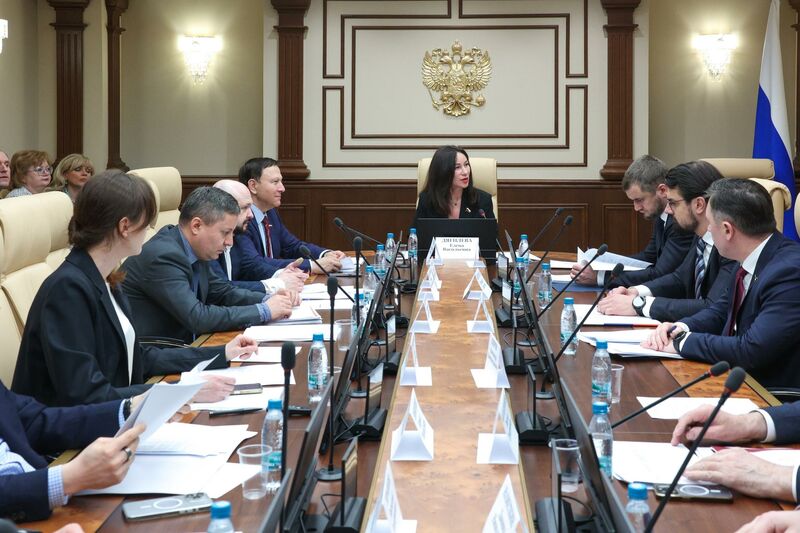
Elena Diaghileva, representative of the Murmansk Region in the Federation Council, held a round table on legislative regulation and mechanisms for implementing a single preferential treatment for the territories of the Arctic and the Far East.
Opening the meeting, the parliamentarian noted the importance of the events being held by the working group established on behalf of the Federation Council Chairman Valentina Matvienko. According to the senator, the dialogue with the participation of representatives of all interested parties makes it possible to form reasonable proposals for adjusting the concept, taking into account macroeconomic indicators and the experience of existing preferential regimes. She recalled that these mechanisms are the most important factor in increasing the investment attractiveness of remote regions.
"Today, there are five main preferments in the Far East and the Arctic, each with its own law and many by-laws. The general idea of a single regime is to unify these mechanisms and make them more accessible to businesses," explained Elena Diaghileva.
According to the parliamentarian, the single preferential treatment, which will begin operating in 2027 on behalf of Russian President Vladimir Putin, should ensure a balance of interests of the state, regions and business.
Vitaly Altabaev, Deputy Minister of the Russian Federation for the Development of the Far East and the Arctic, presented the key parameters of the future draft law. According to him, it is planned to build a single preferential regime based on the principles of supporting new investment projects with a minimum entry threshold of 5 million rubles. It is now planned to establish a five-year grace period for taxes, provision of land and infrastructure for residents.
"The income tax benefit in the current version of the concept is planned to be applied taking into account the profitability criterion. If an investor earns above the average Russian level multiplied by an increasing regional coefficient, then a certain rate will be applied from the excess amount with a distribution in favor of the regional budget. Such restrictions will not apply to projects of technological sovereignty," the representative of the relevant department stressed.
Among the topics raised at the meeting, the parties discussed the need to develop a common understanding on a number of practical aspects, including the methodology for calculating profitability and tax administration mechanisms, the mechanics of seamless transition for existing residents, the relationship of benefits with job creation and the technological level of projects. During the discussion, representatives of the business community also made a number of proposals, including on the preservation of existing land use mechanisms.
Summing up the results of the round table, Elena Diaghileva stressed that the discussion showed the high relevance of the single preferential treatment. According to the parliamentarian, the current concept of the law contains criteria for obtaining resident status, which were noted by senators and representatives of the regions.
"The purpose of the new mechanism is not to take away benefits, but to create a balance of private and public interests. One of the topics discussed is the entry threshold for a resident. On the one hand, the regions are interested in large-scale projects, primarily because of the volume of investments and the large number of new jobs. But on the other hand, the experience of the Murmansk region proves the effectiveness of residents representing small and medium-sized businesses. In particular, such projects are important for remote and sparsely populated areas," explained Elena Diaghileva.
The senator emphasized that the senators' proposals are being introduced into the concept, in particular, the current version has adjusted the investment threshold in favor of lowering it, and the extension of preferential treatment not only to legal entities, but also to individual entrepreneurs is being discussed.
"Since 2020, at the initiative of Governor Andrey Chibis, the preferential regimes of the Russian Arctic and the TOP have attracted hundreds of residents to the Murmansk Region, the total amount of planned investments exceeds 600 billion rubles with the prospect of creating about 15,000 jobs. In order for regions with a harsh climate and a northern rise in prices to become more attractive to live in, and for people to get high-paying jobs, it is necessary to constantly improve investor support mechanisms. Today's discussion allowed us to develop agreed proposals for finalizing the concept and preparing a draft federal law," the senator said.
The event was attended by senators and deputies of the State Duma, representatives of federal and regional authorities, business associations and experts.
/Ministry of Information Policy of the Murmansk Region/