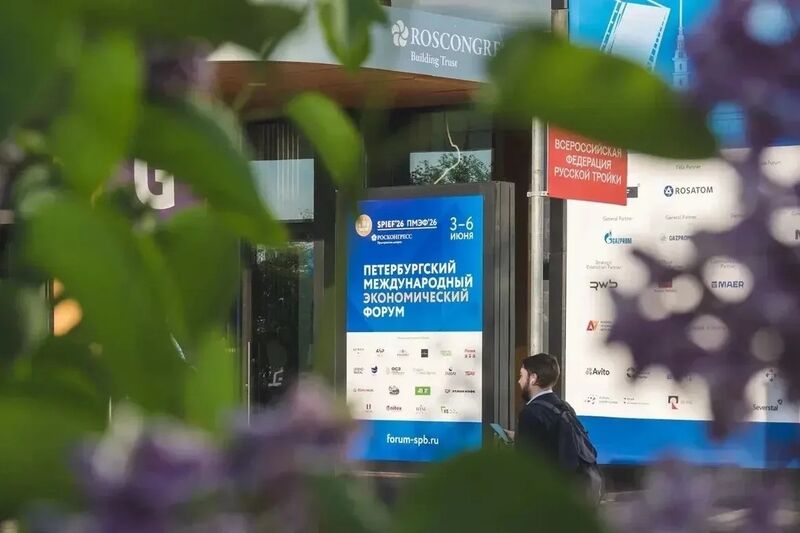
The Governor of the Murmansk Region spoke at the business breakfast of the Russian Union of Industrialists and Entrepreneurs "Regional Aspects of environmental and Climate Policy – the role and opportunities of business", which was held as part of the St. Petersburg International Economic Forum.
Andrey Chibis told how the Murmansk Region manages to maintain a balance between industrial development and the environment, as well as how the region turns environmental challenges into new opportunities for development and investment.
"For us, ecology and economics are not opposed — they are two parts of the same task: the quality of life of people and the sustainable development of the region. The Murmansk Region is the largest industrial center of the Arctic, so our policy is not based on a choice between development and ecology, but on a reasonable balance. Over the past seven years, pollutant emissions have decreased by almost 35%, and the volume of contaminated wastewater has more than doubled. These results were achieved not by reducing production, but by modernizing enterprises, introducing modern technologies, and engaging in constructive dialogue with businesses. For the Arctic, adaptation to climate change is no longer a question of the future, but a necessity of today. At the same time, climate change brings not only challenges, but also new opportunities. The development of the Northern Sea Route, access to new resources and the growing strategic importance of the Arctic open up additional prospects for the development of the region," said Andrey Chibis.
Today, for the third year in a row, the Murmansk Region has been among the top three in the National Environmental Rating and ranks first among the regions of the Northwestern Federal District.
As the governor noted, coal transshipment at the port remains one of the most sensitive environmental issues for Murmansk residents. This has been the way the work has been organized since the days of the Soviet Union. However, in recent years, the region has been systematically solving this problem. Coal transshipment is gradually being transferred to the western shore of the Kola Bay: A modern specialized Lavna terminal is operating, thereby changing the structure of cargo in the urban part of the port, increasing the share of more environmentally friendly ones. Lavna is currently one of the main infrastructure projects in the Murmansk Region, which is being implemented with the support of Russian President Vladimir Putin. Putin.
One of the key topics of the presentation was the potential of waste recycling in the mining industry. Today, most of them are practically unused: about 99% are stored in landfills and tailings dumps. Over the decades of operation of enterprises in the Murmansk region, more than 4 billion tons of such waste have already been accumulated.
"Traditionally, industrial waste and tailings dumps are perceived as an environmental problem. However, modern technology allows us to look at them in a different way. In fact, this is not waste, but a huge reserve of valuable resources that can become a source of raw materials for new industries and new investments," the head of the region emphasized.
According to experts, the enrichment waste alone contains about 1.5 million tons of rare earth metals, more than 100,000 tons of rare metals, about one million tons of zirconium and over 40 million tons of iron ore. The potential value of these resources exceeds 500 billion rubles, and the processing of raw materials accumulated in the tailings dumps of the three largest enterprises in the region can generate revenue of about 6.4 trillion rubles.
The participants of the discussion paid special attention to climate projects and the introduction of modern environmental technologies that simultaneously reduce the burden on the environment and create new points of economic growth.
/ Ministry of Information Policy of the Murmansk Region /