
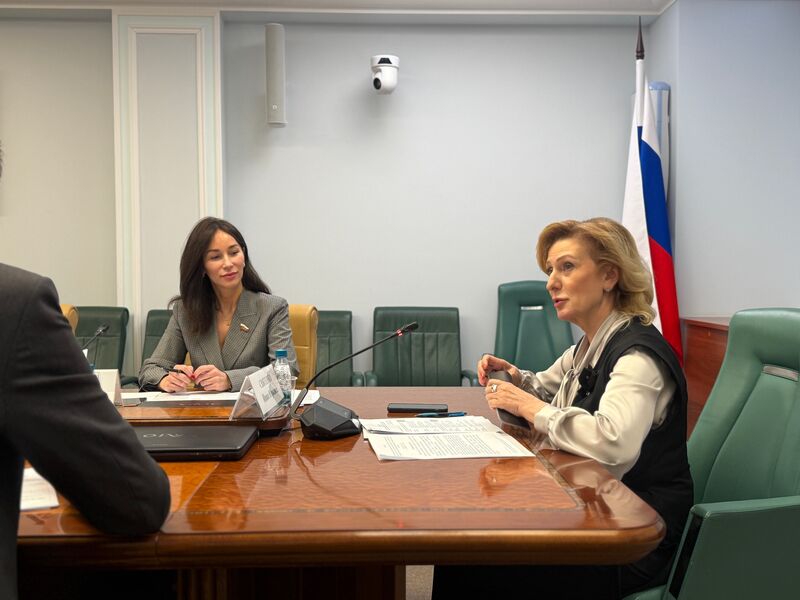
The Federation Council discussed the place of the beauty industry in the creative economy, as well as the industry's role in promoting national identity and innovation. Elena Diaghileva, Senator from the Murmansk Region, moderated the discussion.
According to the senator, the creative economy makes it possible to diversify exports and reset territories. At the same time, 80% of the sector is represented by small and medium-sized enterprises, which makes it crucial to identify promising areas for further development.
"The situation is similar in the beauty industry. The vast majority of those employed in the field are representatives of small and medium-sized businesses. At the same time, if we consider the production of cosmetics and perfumes, then we are talking not only about technological processes and the economic system, but also about the creative component. According to surveys, more than a third of consumers, when choosing domestic brands, are guided by the uniqueness of the formulas, and a quarter by the history of the brand and its visual code," explained Elena Diaghileva.
As the senator emphasized, this confirms the role of cosmetics and perfumes in the formation and export of Russia's cultural code both in the domestic and foreign markets. She emphasized that the formulations, components and visual components of domestic products increasingly reflect the cultural, historical and regional characteristics of the country, which makes them a driver for promoting traditional values, identity, territories, as well as a possible tool for increasing the tourist attractiveness of the subjects.
"I will give an example of my native Murmansk region, where the Northern Design cluster operates, which since 2025 includes the production of cosmetics. The region produces products that include algae, Arctic chaga, willow tea, blueberries, lingonberries and other natural gifts of the Arctic. Employees of the Kola Scientific Center of the Russian Academy of Sciences are involved in the development of formulas, and Kandalaksha has even opened its own organic farm of a local brand," shared Elena Diaghileva.
The senator emphasized the importance of continuous improvement of programs to support entrepreneurs. According to her, the course taken by the Murmansk Region government team, led by Governor Andrey Chibis, makes it possible to maintain a favorable business climate in the region despite the challenges.
"During a recent speech at the Federation Council, Andrey Vladimirovich clearly outlined the role of small and medium-sized businesses in the sustainable development of the Arctic. The Far North is a territory where all business processes are accompanied by an objective increase in prices, but the comfort of residents directly depends on the quantity and quality of entrepreneurial initiatives," said Elena Diaghileva.
Addressing the participants in the discussion, Deputy Chairman of the Federation Council Inna Svyatenko also stressed the importance of promoting national identity through the development of the domestic beauty industry. She recalled that at a meeting with members of the Council of Legislators in St. Petersburg, Russian President Vladimir Putin stressed the importance of developing creative industries and the need to continue to form the legal foundation for advanced industries of technological leadership and integrated territorial development.
"It is necessary to help the domestic manufacturer. The stronger the domestic brand, the more confident it feels both in the domestic market and abroad," emphasized the Deputy Speaker of the Federation Council.
During the discussion, the participants of the round table raised the topics of the readiness of domestic industries for the innovative approach of formula authors and brand owners, the need for scientific research for the development of the industry, the results of the implementation of federal programs, the need to improve the legislative framework in terms of regulating the production of cosmetics and perfumes.
Denis Kravchenko, First Deputy Chairman of the State Duma Committee on Economic Policy, senators of the Russian Federation, representatives of the Ministry of Industry and Trade of the Russian Federation, the Ministry of Economic Development of the Russian Federation, the Ministry of Health of the Russian Federation, the Federal Agency for Technical Regulation and Metrology, the Russian Export Center, expert, scientific and industry communities also took part in the discussion.
/Ministry of Information Policy of the Murmansk Region/
Photo: SF Press Service